By: Ella Levi ’27
Order in the committee. The delegate of Ethiopia will yield her remaining time. A Hydra has escaped from the underworld. Perseus must respond. The DUNE planet has exploded, and a crisis has broken out! The gender gap in STEM demands a resolution, and you have forty-five minutes.
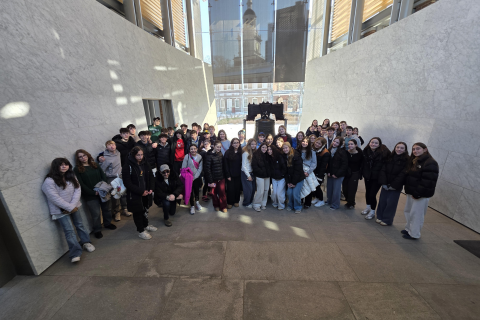
This is Model UN, and for a group of TLS students who recently traveled to the University of Maryland, they experienced two of the most intellectually stimulating days of their high school years. TLS’s Model UN club, led by juniors Abby Kass and Ari Messinger, sent a delegation, meaning a team of students from a specific school, to two conferences this year: Harvard Model United Nations and The University of Maryland’s United Nations Conference. The Maryland trip brought together students from 9th to 11th grade, each representing a different country, or debating a different crisis while impersonating a character, and consequently coming home a different thinker.
Ari Messinger admitted that during his freshman year, “Model UN really was not on my radar,” but he joined the club and never looked back, watching as it has grown so popular that students had to be turned away for this trip. “Our application pool was so large that we actually had to make cuts,” he said. “There’s a very strong desire in the Leffell student population to participate.” In Maryland, Messinger wasn’t debating international trade policy or economics; he was Perseus, the Greek hero, sitting in a Mount Olympus crisis committee, responding in real time to a Hydra that had just escaped from the underworld. Crisis committees are a distinct format from the General Assembly style most people picture when they think of Model UN. Where GA committees can seat 100 to 300 delegates debating broad geopolitical questions, crisis committees are smaller, faster, and far less predictable. Directives, the mechanism by which delegates make their ideas actionable, must be written live as new crises erupt. When the Hydra crisis broke, delegates split immediately over strategy. “Some people wanted to negotiate with the Hydra, others wanted to take it down,” Messinger recalled. His bloc (group of allied delegates within a committee) landed somewhere practical: establish forces to guide civilians into a nearby forest, set up medical tents, and develop an antidote. It worked, at least in the world of the committee.
While Messinger was navigating ancient Greece, junior Maayan Yolkut and freshman Avrie Treiber were across the conference representing Ethiopia in the United Nations Development Programme committee, a General Assembly body of roughly 70 delegates debating the gender gap in STEM. For Treiber, it was her first conference. “I didn’t really know what was going on,” she said, but she got up and did it anyway. By the end, she described it simply: “I felt a lot better, and I was very proud of myself.” Yolkut’s most memorable moment came during an out-of-room working session, when she and the delegate from Germany had to produce a full paper on education in roughly fifteen minutes. “I have a rough time at school working on the spot,” she admitted, “but we got it done, and I was really proud of our efficiency.”
Both delegates credited preparation as essential. The conference is technology-free–no laptops, no phones, no AI–a policy designed for fairness. “No one was on Instagram. It was very committee-based,” Yolkut said. Representing Ethiopia, an underdeveloped nation, she found herself dependent on stronger delegations in ways she hadn’t anticipated. “We needed to be with the UK, and Germany, and Argentina; that was our main goal, just to be able to help, because we couldn’t do it by ourselves.” It made global interdependence feel less like a concept and more like a reality. “It really opened my eyes to how much other countries depend on each other,” she said.
That shift, from ideas to tangible experiences, is what all three delegates pointed to as the deeper value of the experience. “Both the skills and ideas and substance that we learn during Model UN conferences can be applied to real-world decisions and opinions,” Messinger said. Yolkut put it more personally: “It makes me very annoyed when people don’t know what’s going on in the world. This is just a small way of knowing how other countries feel, how you feel about certain issues developing in the world.” For Treiber, the growth was just as real. “I really just wanted to get better at public speaking,” she said, “and I wanted to have fun. I feel like I got both.”
What’s next? Talks are underway to host TLS’s own Model UN conference. For anyone still on the fence about joining, Treiber kept it short: “Just do it. Even if you’re nervous, you always have the team there with you.” And Messinger offered the clearest measure of where things stand: “Our Model UN community at school is a very, very strong one, and I think it’s only growing from here.”
Order in the committee. The chair recognizes all interested delegates!